Having trouble submitting? Email us directly at nicole@beauway.com and we'll get back to you within 24 hours.











Tail Lift Mechanism Wear Points: A Technician’s Inspection Order
Tail Lift Mechanism Wear Points: A Technician’s Inspection Order
A tail lift mechanism goes through thousands of load cycles over its service life. Wear rarely announces itself until a joint seizes or a seal starts weeping oil. Knowing where to look — and in what order — separates a routine inspection from an unplanned breakdown on a delivery route.
What Happened in Manchester, UK — Late Winter Service Round
A regional parcel delivery fleet ran box trucks fitted with hydraulic tail lifts. Drivers reported a knocking noise during platform descent, most noticeable near the end of the lowering stroke. The noise had developed gradually over several weeks of daily loading cycles in wet, salted road conditions. A technician inspected the unit and found measurable play at the pivot pin connecting the lift arm to the platform. The manufacturer’s maintenance procedure called for replacement rather than continued monitoring at this stage. Repeated exposure to road spray had washed grease out of the bearing — a common cause of accelerated pivot wear in winter conditions. The technician replaced the pin and bushing, then regreased the joint until a visible grease collar formed on both sides of the bearing. This collar is the standard method for sealing a pivot against water, salt, sand, and dirt. The technician cycled the tail lift several times under load before returning it to service. Total downtime stayed under two hours, on a fleet that runs tail lifts for cold-chain and parcel distribution routes almost continuously.
Why the Tail Lift Mechanism Wears Faster Under Daily Fleet Use
A tail lift mechanism is built for a long service life of repeated cyclical loading, but real-world wear rates vary sharply depending on how a tail lift truck operates. Standard cantilever tail lifts commonly carry a rated capacity from around 500 kg up to 3,000 kg. Heavier slider and underrun models reach 5,000–9,000 kg for specialised freight applications. Vehicles running multiple stops per day wear out faster. So do vehicles operating in wet or salted road conditions, or those regularly loading close to rated capacity. These conditions accelerate wear at pivot points and bearings long before hydraulic components show any issue. Cold-chain and last-mile delivery operations expose the tail lift mechanism to more moisture and temperature cycling than long-haul freight applications do. This is why manufacturers typically recommend shorter lubrication and inspection intervals for vehicles used this way.
Common Wear Points in the Tail Lift Mechanism
Four areas account for most of the mechanical wear technicians find during routine servicing:
Pivot pins and bushings carry the full dynamic load of the platform and lift arms. Manufacturer maintenance procedures specify a measurable play tolerance for each pin and bushing type. Once play exceeds that tolerance, technicians replace the component rather than repack it, since play at this stage tends to accelerate rather than plateau.
Lift arms and linkages show wear through visible bending, surface pitting, or uneven wear patterns. These signs often indicate the tail lift mechanism has operated with off-centre loads beyond the platform’s centre-of-load rating, which the tail lift’s load chart specifies.
The platform folding mechanism takes stress from repeated folding and unfolding at the hinge assembly and its end-stops. A well-maintained hinge moves through its full range without binding. If the platform fails to reach full working position at vehicle floor level, technicians should check the end-stops and refit them correctly.
Mounting brackets and bolted connections carry safety-critical loads, since most cantilever tail lifts bolt to the vehicle chassis rather than weld to it. Technicians must check bolt torque with a calibrated torque wrench against the manufacturer’s prescribed values. These values vary by bolt size and strength class — published manufacturer torque tables list roughly 26 Nm for a mid-size M12 bolt under pull-stress loading, rising well above 100 Nm for larger M16–M24 structural bolts.
Hydraulic Tail Lift Specific Wear Points
Most tail lift trucks in commercial fleets use hydraulic actuation, so the hydraulic circuit deserves its own inspection pass separate from the mechanical linkage:
- The pressure relief valve setting matters most here. Manufacturer manuals typically specify an absolute upper limit for system pressure — published examples cap standard cantilever units at 220 bar / 3,190 psi. Technicians should test the relief valve so the platform lifts its rated capacity but stalls when overloaded by a set margin above that. This confirms the valve protects the system rather than compensating for wear elsewhere.
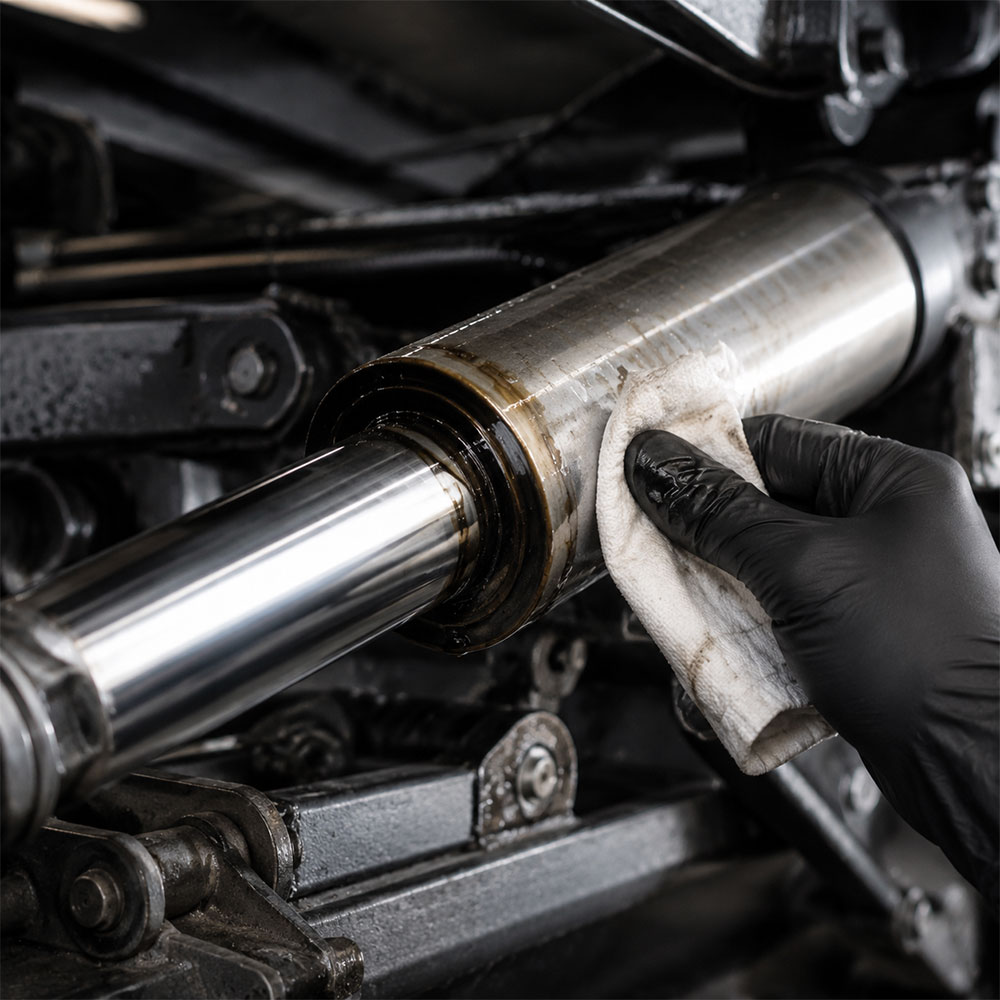
- Cylinder rods and seals should show no pitting, scoring, or visible oil weeping after a full lift-lower cycle. Rod damage accelerates seal wear at the next service interval.
- Hoses and fittings need a check for surface cracking near crimped ends. Technicians should verify fitting torque against the manufacturer’s spec — published banjo-coupling torque values for a standard M10 fitting run around 18 Nm, though this varies by fitting size.
- Hydraulic fluid needs a check for contamination or discolouration at each scheduled service, alongside a check of the whole hydraulic circuit for leaks at rest and under operation.
Technician’s Step-by-Step Inspection Order
| Step | Component | Check Item | What to Verify | Typical Frequency |
|---|---|---|---|---|
| 1 | Hydraulic system | Oil leaks | No visible leaks during operation or at rest | Daily visual check |
| 2 | Pressure relief valve | Overload test | Platform lifts rated capacity but stalls at the manufacturer’s set overload margin | Scheduled service |
| 3 | Pivot pins & bushings | Clearance / play | Within manufacturer-specified tolerance; replace if exceeded | Scheduled service |
| 4 | Cylinder rods | Surface condition | No pitting, scoring, or corrosion | Scheduled service |
| 5 | Platform & folding hinges, end-stops | Alignment, free movement | Platform reaches full working position flush with vehicle floor | Scheduled service |
| 6 | Bolted connections | Torque | Checked with calibrated torque wrench against prescribed values | Scheduled service, and after any weight test |
| 7 | Mounting brackets | Structural integrity | No visible cracking at welds or bolted joints | Annual / periodic inspection |
This order reflects priority, not just convenience. Hydraulic leaks and pivot play progress fastest and pose the most immediate risk to safe operation, so technicians check them first. Structural checks happen less often, but they remain a mandatory part of the manufacturer’s periodic maintenance and inspection programme. Published manufacturer maintenance schedules for the tail lift mechanism on standard cantilever units typically call for full servicing every 90 days or after a set number of operating cycles (commonly cited around 1,750 cycles), whichever comes first. Manufacturers also recommend an additional annual service ahead of winter and after every high-pressure wash.
How Often Should You Inspect the Tail Lift Mechanism?
Inspection frequency should track usage intensity rather than a fixed calendar alone. A tail lift truck used for high-frequency urban delivery reaches a manufacturer’s cycle-based service threshold faster than a lower-frequency depot-to-depot vehicle does, even on the same calendar schedule. Fleet operators should also follow the manufacturer’s guidance and service a hydraulic tail lift after every high-pressure wash and before winter. Manufacturer maintenance documentation flags both events as accelerants of pivot and bushing wear.
When to Repair vs Replace Tail Lift Mechanism Components
Not every worn component needs full replacement. Pivot pins and bushings within tolerance can stay in service, provided lubrication continues and the bearing keeps its grease collar. Once measured play exceeds the manufacturer’s specified tolerance, replacement becomes the only approved path, since continued operation accelerates wear on the mating lift arm bore. Hydraulic seals showing early weeping can sometimes take a seal kit rather than a full cylinder replacement, provided the rod surface itself shows no damage. Structural cracking at welds or mounting brackets works differently — technicians should never treat it as a monitor-and-wait item. It calls for immediate assessment by a qualified technician, in line with the manufacturer’s structural inspection requirements. Technicians sourcing parts for repair will find that folding tail lift options and hydraulic tail lift cylinder assemblies typically come available as like-for-like replacements matched to the original mechanism specification, which helps preserve the rated load and cycle life of the unit.
Closing Notes
A tail lift mechanism that receives consistent, prioritised inspection rarely fails without warning — the wear patterns above develop gradually, and technicians can catch them well before they become safety issues. Fleet technicians who follow the manufacturer’s documented maintenance schedule, rather than reacting only to reported noise or leaks, typically see meaningfully longer service life from both the mechanical linkage and the hydraulic circuit.
Trusted by Fleet Operators Across 60+ Countries
Stop Losing Time at the Loading Dock.
Get a Custom-Matched Tail Lift Quote in 24 Hours.
60
Countries Served
24h
Quote Turnaround
99.9
Field Uptime
5.0
Customer Rating
No Obligation
CE & UKCA Certified
Standard & Custom Builds
Worldwide Shipping