Having trouble submitting? Email us directly at nicole@beaway.com and we'll get back to you within 24 hours.








Anti-Corrosion Tail Lift: Coating Options and When You Need One
Anti-corrosion tail lift guide: coating options compared, when you actually need one, and how to verify protection.
Why the Platform Edge Rusts Through First
On trucks running coastal routes, the edge of a tail lift platform often rusts through before the truck body does. This is true whether the truck tail lift is a folding, cantilever, or column-style unit — in North America, people commonly call it a liftgate.
Any hydraulic tail lift structure exposes both the hydraulic cylinder and the steel platform to salt fog and moisture in the same way. The root cause usually comes down to one question: does the coating system match the operating environment?
Corrosion protection is what actually determines the working lifespan of an anti-corrosion tail lift.
An anti-corrosion tail lift’s resistance depends less on its base metal. It depends more on whether the coating system matches the vehicle’s operating environment.
The coating system — not the base metal — is what actually determines how long a tail lift platform lasts in a corrosive environment.
This is the starting point for deciding whether extra corrosion protection is worth the investment.
A common scenario in the industry: a vehicle operates for years on coastal routes, in high humidity, or on roads frequently treated with de-icing salt. Rust spots typically appear first at the platform edges, hinge gaps, and bolt heads. Owners often don’t connect this to coating grade until maintenance frequency has already climbed noticeably.
Another common pattern: buyers purchase vehicles in the same batch and split them between coastal and inland routes. Years later, the difference in corrosion severity is stark. So is the gap in total maintenance cost. Procurement decisions usually set this divergence in motion, though buyers rarely recognize it as significant at the time.
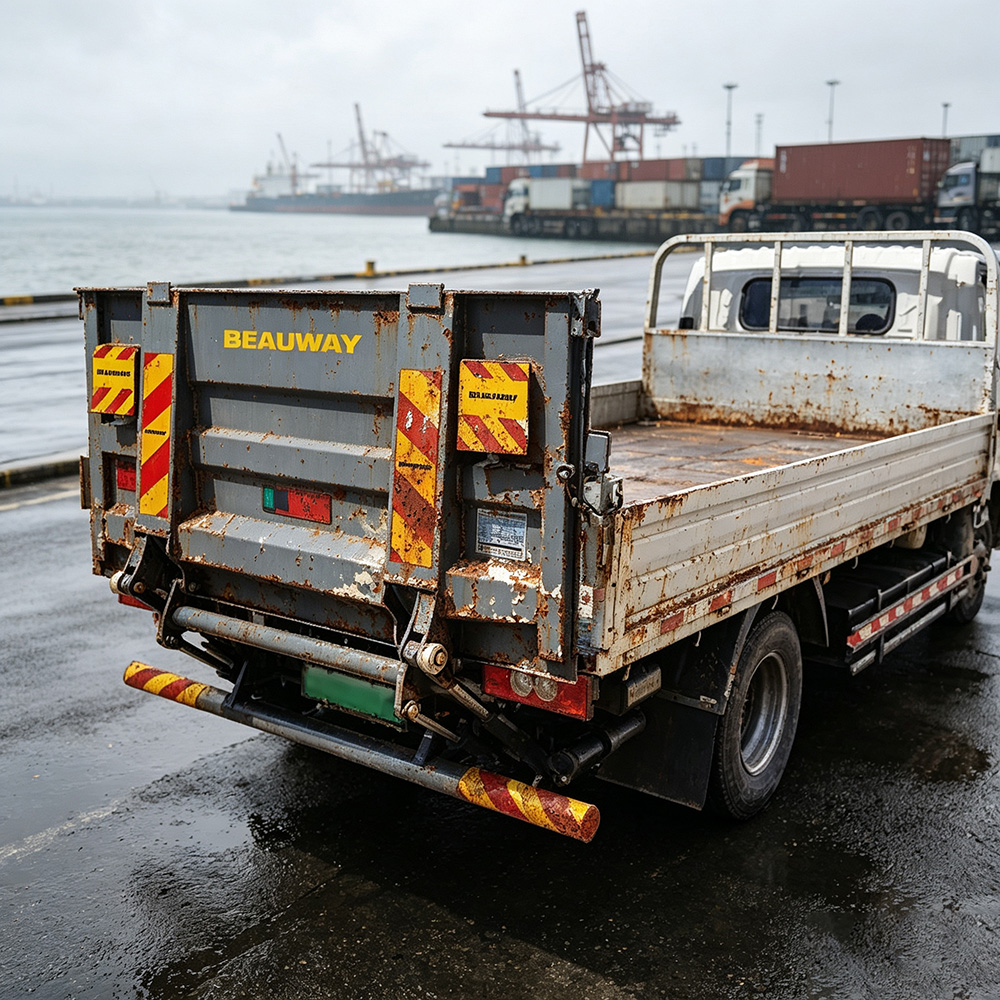
Why Coastal and High-Humidity Environments Accelerate Anti-Corrosion Tail Lift Wear
Chloride ions in salt fog penetrate the micro-pores of ordinary coatings. This forms localized electrochemical corrosion on the metal surface. This process is especially pronounced in the typical operating conditions of a marine grade hydraulic platform.
Coastal fleet equipment corrosion usually shows up as paint blistering, rust starting at corners and edges first, and fasteners seizing and becoming difficult to remove. Humidity, temperature swings, and salt exposure compound each other. Together they accelerate corrosion several times faster than in inland environments.
For fleets that regularly run to ports, ferry terminals, or coastal warehouses, corrosion-resistant coating selection isn’t a nice-to-have. It’s a baseline requirement.
Different tail lift structures also expose gaps differently. The fold seams on folding lifts, the arm connection points on cantilever lifts, and the guide rail sections on column lifts are all spots where salt tends to accumulate. Coatings wear from friction in these same spots. Structural type should factor into coating selection alongside environment.
Comparing Anti-Corrosion Tail Lift Coating Options
A complete anti-corrosion hydraulic platform solution fundamentally combines coating process and structural design choices. Different coating processes vary significantly in corrosion resistance, upfront cost, and maintenance difficulty. The table below compares common industry processes for reference during selection:
Coating OptionCorrosion Protection MechanismTypical Thickness / StandardSuitable EnvironmentMaintenance CharacteristicsHot-dip galvanizingZinc layer provides sacrificial anodic protection to the base metalPer ASTM A123, structural steel ≥1/4″ thick requires a minimum coating thickness of roughly 100 microns (3.9 mils)Coastal, high-humidity, industrial corrosion zonesHighly durable; still offers protection even with surface scratches; the thicker the coating, the longer the interval before first maintenancePowder coatedResin coating provides a physical barrier against air and moistureStandard single-coat thickness is 60–100 microns; two-coat systems with epoxy primer can exceed 100 micronsGeneral urban transport, dry regionsStrong appearance/color options; can rust locally once scratched; single-coat vs. two-coat systems differ significantly in corrosion lifespanStainless steelChromium self-passivates to form a protective filmCommonly grade 304 or 316; 316 contains molybdenum for stronger resistance to chloride-induced corrosionChemical, food, high-salt-fog scenariosHigher cost, near-zero maintenanceAnodized aluminumForms a dense oxide layer on the surfaceType II (conventional anodizing): roughly 5–25 micron film, favoring appearance and general corrosion resistance; Type III (hard anodizing): film up to 25–100 microns, higher hardness, commonly used on guide rails, hinges, and other wear-prone areasLightweight vehicle types, general coastal environmentsCorrosion resistant and weight-saving; scratch repair is relatively simple
The core selection criterion is the corrosivity of the operating environment — not how often the platform is used. A vehicle running short, dry inland routes needs a noticeably lower coating grade than one running long coastal routes.
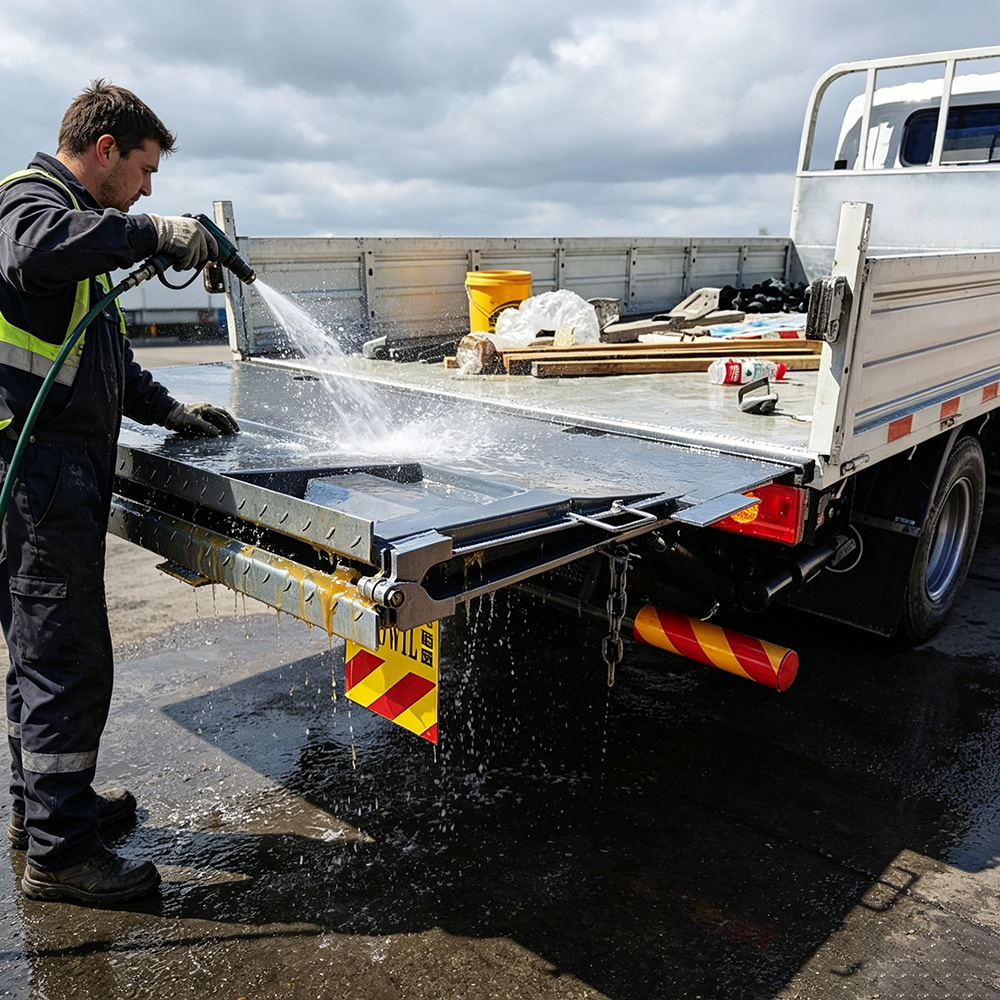
Cost Trade-offs Between Coating Options
From a cost standpoint, a hot-dip galvanizing platform or powder coated hydraulic lift solution typically carries a lower upfront cost. It may run higher long-term maintenance costs in high-corrosion environments, though.
Switching to a stainless steel loading platform or anodized aluminum platform raises upfront cost. In exchange, it lowers the rate of later repairs.
A direct galvanized vs powder coat comparison makes the difference clear: galvanizing’s sacrificial anodic protection keeps working even after a local scratch. Powder coating, once breached, allows rust to spread quickly from the damaged spot. Along the same lines, a galvanized loading platform can extend the repair cycle several times over compared with an ordinary carbon steel platform in coastal environments.
Coating selection is fundamentally a trade-off between upfront cost and long-term maintenance cost, not a simple unit-price comparison.
Looking at how leading manufacturers actually approach this can also help judge whether a coating grade is adequate. Some major European tail lift manufacturers apply multi-layer composite processes to steel structural components — for example, combining tri-cation zinc phosphate treatment with a KTL epoxy electrocoat primer, then a polyester powder topcoat. They list hot-dip galvanizing as a standard process on some product lines rather than an optional upgrade.
The core idea behind these multi-layer systems is protecting both inside and out: an electrocoat primer can reach the interior surfaces of steel components that ordinary spraying can’t.
Buyers can use this kind of process combination as a benchmark. It helps them judge whether a supplier’s coating solution is a single step or a composite system.
Hydraulic System and Fastener Protection for an Anti-Corrosion Tail Lift
Surface protection on the platform is only the first layer. A corrosion resistant hydraulic system needs attention too. The hydraulic cylinder and hose fittings are exposed to moisture for long periods. Buyers overlook these more easily than the exterior steel panels.
The common approach for an anti-rust hydraulic cylinder is applying a hard chrome plating to the piston rod surface, typically 10–30 microns per side. Too thick, and it becomes brittle and prone to flaking; too thin, and it lacks wear resistance. The cylinder bore is precision-honed to control surface roughness and fit tolerance.
Together, these reduce direct contact between moisture and the piston rod metal. They also extend seal life.
When choosing a qualified corrosion resistant hydraulic supplier, ask for thickness and hardness test data on the piston rod’s chrome plating. Also ask for documentation of seal-to-hydraulic-fluid chemical compatibility — not just a cosmetic warranty on the platform.
Corrosion resistant fasteners and hinges are easy to overlook. But these are exactly the moving parts where corrosion directly affects opening/closing smoothness and structural safety, not just appearance.
Once a bolt seizes from rust, maintenance usually requires cutting it out and replacing it. That costs far more than the price difference of specifying a higher corrosion-grade fastener up front. This is why professional procurement specs typically call out fastener corrosion treatment separately, rather than assuming it’s bundled by default with the platform.
If the vehicle also needs to operate in cold climates, the interaction between the coating system and hydraulic fluid properties can affect startup performance — related analysis is available in this piece on how hydraulic tail lift performance changes in cold climates.
How to Verify an Anti-Corrosion Tail Lift’s Protection Grade
Judging whether a coating truly delivers corrosion protection can’t rely on appearance alone. It needs verifiable testing and warranty documentation to back it up.
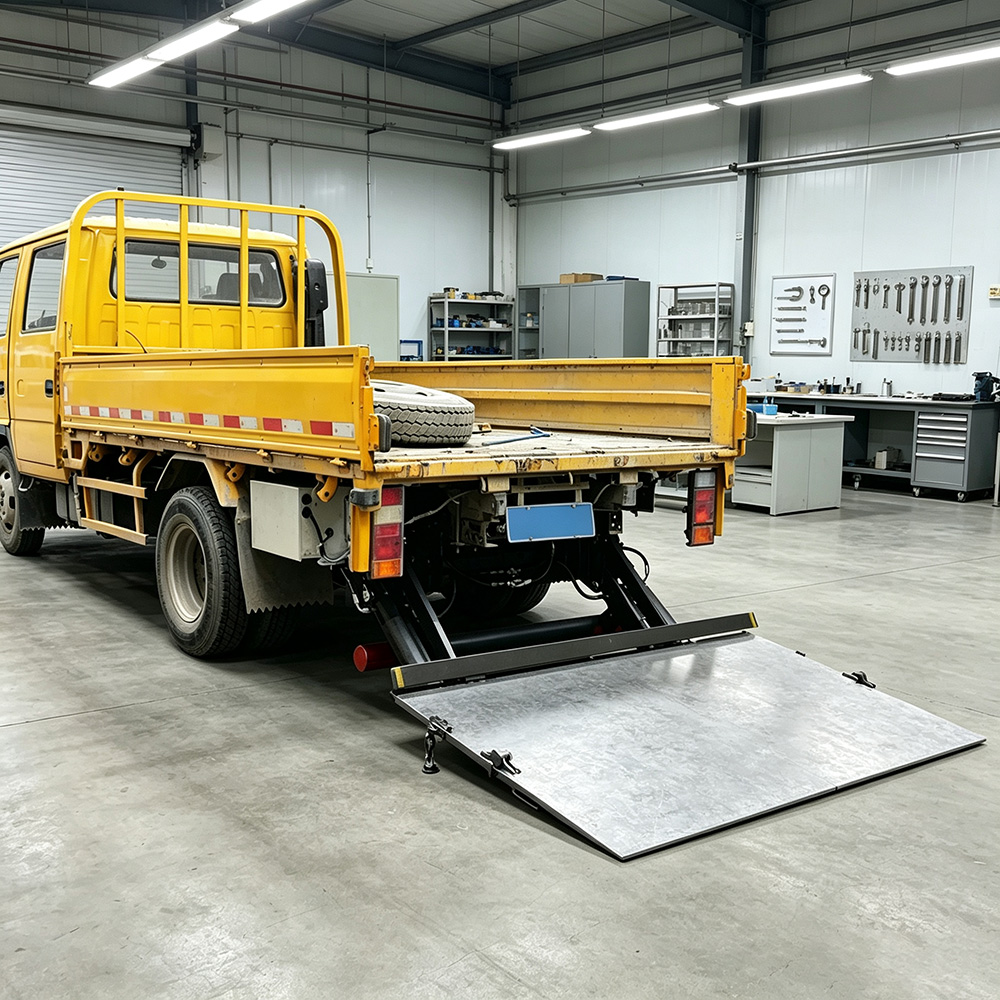
Salt Spray Test Standards
A salt spray test hydraulic platform undergoes is the industry’s standard accelerated corrosion test method. It follows international standards such as ASTM B117, using continuous salt fog exposure to simulate long-term corrosion. The test assesses whether a coating shows rust, blistering, or loss of adhesion within a given timeframe.
ASTM B117 itself only defines how to operate the test chamber and salt fog environment. It does not specify how many hours a coating must survive to “pass.” The buyer or the relevant product specification sets that threshold separately.
Common industry ranges vary widely: decorative small parts might only get tested for 24–96 hours. Structural, coastal, or marine-use coatings typically need to exceed 500 hours. Some heavy-duty corrosion-protection structural components get tested for several thousand hours.
So when reviewing a test report, don’t stop at “passed the salt spray test.” Check how many hours it was actually tested for and which product standard was used to define a pass.
When running a corrosion resistant coating comparison, verify three things at once:
- Whether the coating process is clearly named
- Whether there’s a third-party test report
- Whether the anti-corrosion warranty on the hydraulic platform you’re offered covers structural rust damage, not just cosmetic issues
This is also a practical way to judge whether a tail lift manufacturer is professional. A legitimate tail lift supplier will typically volunteer coating test reports rather than waiting to be asked.
Choosing a supplier with a mature approach to coastal climate equipment coating costs less than dealing with the fallout later. Some suppliers offer a separate heavy-duty coating option for coastal customers — it’s worth asking about proactively during procurement.
Different tail lift structures also expose hinges and moving parts differently; for more on this, see this comparison of column-style tail lifts against other structural types.
Reading the Warranty Terms
The wording of warranty documents is also worth scrutinizing carefully. Some warranty terms cover mechanical failure only, with a separate exclusion clause for corrosion-related structural issues. Confirming this line by line before purchase avoids disputes later.
Maintenance to Extend Anti-Corrosion Tail Lift Coating Lifespan
Even the best coating fails faster without routine maintenance. The basics of anti-corrosion platform maintenance aren’t complicated, but they need to become a regular habit. This applies to any tail lift platform, regardless of structural type or coating process.
Common rust prevention hydraulic lift maintenance steps include:
- Regularly rinsing off salt residue and grit buildup, especially in gaps and fold seams
- Checking coatings for exposed scratches and touching them up promptly
- Applying anti-rust grease to hinges and bolted joints
- Checking the hydraulic cylinder’s piston rod surface for pitting
These steps are low-cost, but they directly affect the coating’s real service life. Crews neglect them long-term more often than they neglect coating selection itself.
For coastal or heavy de-icing-salt environments, fold coating inspection into the regular maintenance cycle. Don’t wait until rust becomes visibly obvious. Catching a local rust spot early costs far less to fix than a large-scale repaint.
Conclusion: Do You Need an Anti-Corrosion Tail Lift?
Taken together, the decision comes down to three factors:
- The corrosivity of the operating environment
- Whether the coating process matches that environment
- Whether there’s verifiable testing and warranty backing it up
Check your vehicle’s actual operating routes against these questions — coastal or not, humid or not, exposed to de-icing salt or chemical agents or not. Evaluate platform material and coating type item by item, rather than judging on price or appearance alone.
The value of an anti-corrosion tail lift ultimately shows up in long-term operating cost, not on the purchase quote.
FAQ
Q: What is an anti-corrosion tail lift?
A: An anti-corrosion tail lift is a hydraulic loading platform treated with a coating system — such as galvanizing, powder coating, or anodizing — designed to resist rust in humid, coastal, or chemically exposed environments.
Q: How does galvanizing compare to powder coating for corrosion resistance?
A: Hot-dip galvanizing offers sacrificial protection that keeps working even after surface scratches. Powder coating relies on an intact physical barrier and can rust locally once damaged.
Q: Why do coastal fleets need marine grade hydraulic platforms?
A: Salt-laden air accelerates electrochemical corrosion. Marine grade coatings and stainless or anodized components slow this process significantly compared to standard finishes.
Q: Can a salt spray test predict real-world corrosion performance?
A: A salt spray test (per ASTM B117) is an accelerated simulation, not a direct real-time equivalent. It provides a standardized way to compare coating durability across products.
Q: How often should anti-corrosion maintenance be performed?
A: Frequency depends on operating environment, but rinsing salt residue, inspecting coating integrity, and lubricating hinges on a regular cycle is standard practice for coastal or high-humidity operations.
Q: Is a liftgate the same as a tail lift?
A: Yes, liftgate is simply the North American term for what is called a tail lift elsewhere. A truck liftgate and a truck tail lift both describe the same hydraulic loading platform mounted at the rear of a truck.
Q: How do I evaluate a tail lift manufacturer’s corrosion protection claims?
A: Ask a truck tail lift manufacturer or hydraulic tail lift supplier for documented salt spray test results and warranty terms that explicitly cover structural rust damage, not just cosmetic finish. Verbal assurances alone are not sufficient evidence of coating quality.
Trusted by Fleet Operators Across 60+ Countries
Stop Losing Time at the Loading Dock.
Get a Custom-Matched Tail Lift Quote in 24 Hours.
60
Countries Served
24h
Quote Turnaround
99.9
Field Uptime
5.0
Customer Rating
No Obligation
CE & UKCA Certified
Standard & Custom Builds
Worldwide Shipping