Having trouble submitting? Email us directly at nicole@beauway.com and we'll get back to you within 24 hours.











How to Choose a Dock Leveler Supplier: 7 Checks Before You Order
Choosing a dock leveler supplier involves more than comparing prices or reviewing product catalogs. A dock leveler must fit the loading dock, accommodate the vehicles and material-handling equipment used on site, meet applicable safety requirements, and remain serviceable throughout its working life. A low initial price may not represent good value if important components are excluded, installation dimensions are incorrect, or replacement parts are difficult to obtain later.
A reliable dock leveler supplier should provide clear technical specifications, verifiable quality records, realistic delivery commitments, and written commercial terms. Buyers also need to understand exactly what is included in the quotation and who is responsible for installation, transportation, commissioning, and after-sales service.
For purchasing managers, warehouse operators, distributors, and project contractors, the real challenge is to determine whether a supplier can meet the project’s requirements before production starts. This requires a structured evaluation of technical suitability, customization, quality control, commercial terms, delivery arrangements, and long-term support.
This guide explains seven checks to complete before placing an order. Each section focuses on practical questions, documents to request, and risks to address before committing to a supplier.

1. Evaluate a Dock Leveler Supplier’s Experience and Project Fit
Review Relevant Projects and Product Experience
A supplier’s experience is most valuable when it relates directly to your application. When evaluating a dock leveler supplier, ask whether it has supplied equipment for facilities with similar vehicle types, loading frequency, operating conditions, and installation requirements.
A busy distribution warehouse may have different priorities from a facility that handles occasional deliveries. Projects involving several loading bays may also require closer coordination of dimensions, production schedules, packaging, and installation arrangements.
Ask for relevant project references, technical documents, product photographs, or case descriptions that the supplier is authorized to share. Look for evidence of comparable applications rather than relying solely on general marketing claims.
When reviewing a project example, establish what the supplier actually provided. A company may have manufactured the equipment, coordinated sourcing, supplied technical documentation, or supported installation. These roles are different and should not be treated as equivalent.
A useful project reference should help answer three questions:
- Was the equipment suitable for a comparable loading application?
- Were the technical specifications and delivery requirements clearly defined?
- Can the supplier explain how the requirements were verified before delivery?
A supplier should also be able to explain the capabilities and limitations of its proposed product. If a project requires a particular platform width, operating range, electrical configuration, or installation arrangement, ask whether the proposed model meets those requirements and request supporting documentation.
Clarify Responsibilities and Capabilities
Companies supplying dock levelers may act as manufacturers, distributors, or project suppliers. The important issue is whether the responsibilities relevant to your order are clearly defined.
Ask who will be responsible for confirming technical specifications, approving drawings, coordinating production, conducting inspections, arranging transportation, and handling product defects.
A qualified loading dock equipment supplier should explain which services are included in the offer and which require separate arrangements. This is particularly important if a project involves site preparation, electrical connections, unloading, commissioning, operator training, or on-site technical support.
Do not assume that purchasing equipment automatically includes installation or commissioning. Likewise, a company that supplies equipment may not automatically be responsible for preparing the loading dock or connecting the site’s electrical system.
Before moving forward, clarify the division of responsibilities in writing. This is especially important when several contractors or service providers are involved in the same project.
Evaluate Communication and Documentation
Communication quality is an important part of supplier evaluation. Before ordering, observe whether the supplier answers technical questions directly, identifies missing information, and records important decisions in writing.
Pay particular attention to changes made during discussions. If the platform dimensions, operating range, electrical requirements, or other specifications change, the quotation and drawings should reflect the same approved configuration.
A quotation prepared without sufficient project information may rely on assumptions that have not been checked. Ask the supplier to identify unresolved questions rather than allowing them to carry through into production.
A professional dock leveler supplier should be able to provide a clear sequence of technical review, drawing approval, production, inspection, and delivery. The purpose is not to create unnecessary paperwork. It is to ensure that the buyer and supplier work from the same information.
Clear documentation is more useful than a general promise of good quality because it gives both parties a reference for checking what was ordered and what was delivered.
2. Confirm Technical Requirements with Your Dock Leveler Supplier
Define the Application and Site Conditions
Before requesting a quotation, provide the supplier with the information needed to assess product suitability. Relevant details include:
- The facility layout and expected loading frequency
- The types of vehicles using the loading dock
- Typical vehicle bed heights and loading conditions
- The forklifts or other material-handling equipment used
- The available electrical supply
- The number of loading bays and differences between them
- Environmental conditions and site restrictions
The relationship between the loading dock and vehicle bed is particularly important. A dock leveler must provide a suitable operating range for actual loading conditions. A platform may fit the opening but still be unsuitable if it cannot accommodate the required height difference.
For one product range, the recommended loading dock height is approximately 1.2–1.3 m above ground level. This is a product-specific recommendation, not a universal requirement for every loading dock. The final selection should account for vehicle bed heights, the site layout, and the approved installation drawing.
If the project involves several loading bays, confirm whether each bay has identical requirements. Similar-looking bays may differ in dimensions, vehicle access, traffic patterns, or surrounding construction. Applying one specification to every location without checking can lead to incorrect quotations and installation problems.
A capable dock leveler supplier should ask for the information necessary to assess these conditions instead of selecting a model solely from a brief product description.
Check Dimensions and Pit Requirements
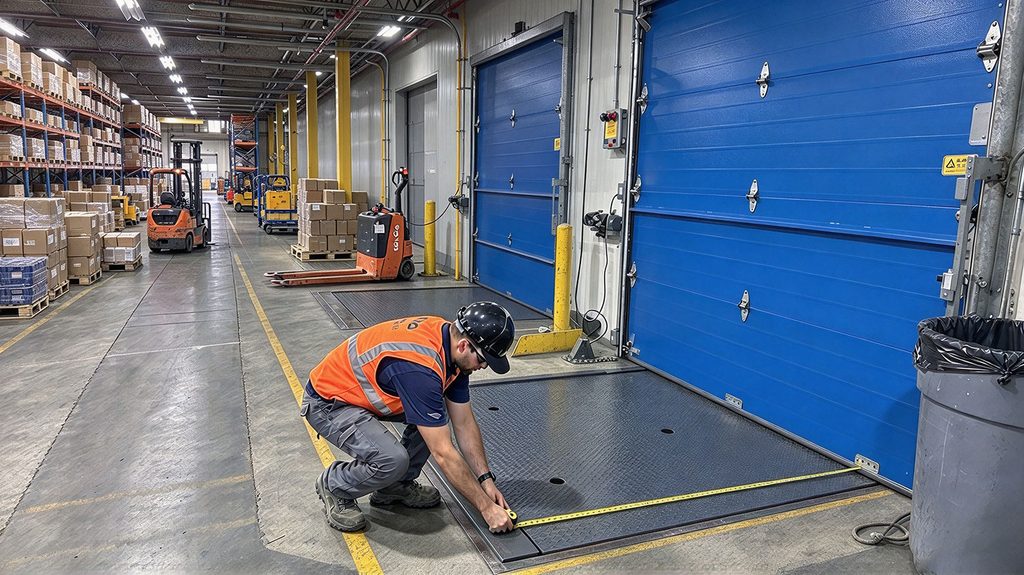
Dimensions should be stated clearly in both the quotation and technical drawing. Do not rely on shorthand size descriptions alone, because different measurements may describe the platform, its closed position, or the installation opening.
One common configuration in the product range covered by this guide is described as 6 × 8 ft, with a nominal platform width of 1,830 mm and a platform length of 2,430 mm. Other available platform widths include:
- 1,830 mm (6 ft)
- 1,980 mm (6.5 ft)
- 2,130 mm (7 ft)
The stated closed length for the common configuration is 2,280 mm, measured with the lip plate in the closed position. Overall platform length and closed length are different measurements and must not be used interchangeably.
For the relevant design, the specified pit opening width is the platform width plus 40 mm. This is a product-specific installation guideline, not a universal allowance for every dock leveler. The final opening dimensions and tolerances must be confirmed against the approved pit drawing before construction begins.
Closed height also needs a clear definition. The product information identifies a 500 mm standard closed height for the specified configuration. Buyers should confirm that this value applies to the model being ordered and ensure it is not confused with pit depth or vertical operating travel.
A dimension check should cover more than nominal width and length. Confirm:
- Overall platform dimensions
- Closed dimensions and the position in which they are measured
- Pit opening width and length
- Closed height and installation depth, where applicable
- Required clearance and installation tolerances
- Any differences between standard and customized configurations
Do not use a product’s nominal dimensions as a substitute for the approved installation drawing.
Verify Capacity and Other Technical Specifications
Technical specifications should identify the exact model and the conditions under which its ratings apply. For the example product configuration, the stated specifications are:
- Static load rating: 10 tonnes, with the platform level
- Dynamic load rating: 6 tonnes, with the platform inclined
- Platform plate thickness: 8 mm
- Lip plate thickness: 14 mm
Static and dynamic ratings describe different loading conditions. They should not be compared as though they were the same measurement. Ask the supplier to explain the rating basis and confirm that the proposed equipment suits the intended application.
When reviewing capacity, consider the handling equipment, the load it carries, how the load is distributed, and the conditions under which the equipment will operate. Do not select a dock leveler solely by looking at the weight of the goods being moved.
The term “static load” in the product information refers to loading when the dock leveler is in the specified level position, while “dynamic load” refers to loading when the platform is inclined. These definitions should be checked against the manufacturer’s formal technical documentation before publication or use in a purchasing specification.
The stated plate thicknesses should also be verified against the approved design. Plate thickness is one factor in product evaluation, but it does not independently establish overall quality, structural performance, or suitability. The complete design, rated capacity, materials, workmanship, and supporting documentation still need to be considered.
A professional dock leveler supplier should be able to explain which product documents support the stated ratings and how the proposed model meets the agreed requirements.
Confirm the Operating Range
The operating range determines the vertical difference the dock leveler can accommodate relative to the loading dock. It should be selected against actual vehicle and site conditions rather than assumed from the product category.
The example product information includes two configurations:
- A standard range of +400 mm upward and −300 mm below dock level
- A commonly promoted range of ±300 mm for another configuration
These values are not equivalent. The first allows a different upward and downward travel range from the second. Buyers should ask the supplier to identify the exact model and state both the upward and downward operating limits in the quotation and technical drawing.
Do not combine figures from different configurations or use one range to describe the entire product range. If the site has unusual vehicle bed heights or operational restrictions, confirm the proposed range before construction or production.
Confirm Electrical and Control Requirements
Electrical compatibility should be confirmed before the purchase order is issued. The example product configuration supports 220 V or 380 V AC, uses a 0.75 kW power unit, and normally operates at 50 Hz. An export order requiring 60 Hz must specify this in advance.
Buyers should not assume that voltage and frequency are automatically suitable simply because the equipment can be supplied internationally. Confirm the available site power and ask the dock leveler supplier to document the final electrical configuration.
Control-box configuration also needs to be stated explicitly. The standard configuration described here uses a plastic control box and does not include an emergency-stop button. Buyers must not assume that an emergency-stop function is included. Any required control and safety features should be agreed upon in the specification and checked against applicable site requirements.
Complete the technical review in this order:
- Confirm the site layout, vehicle requirements, and loading conditions.
- Approve the platform dimensions, pit opening, closed height, and operating range.
- Confirm the capacity ratings and the conditions under which they apply.
- Verify voltage, frequency, power rating, controls, and required safety features.
- Obtain the final technical drawing and written specification.
- Confirm that the approved documents match the final quotation and purchase order.
These figures describe specific product configurations. They must not be presented as universal specifications for every dock leveler.
3. Review Dock Leveler Customization Options Before Ordering
Identify Essential Requirements
Not every loading dock uses the same layout or operating arrangement. Depending on the product range, dock leveler customization options may include platform dimensions, operating range, electrical configuration, controls, surface finish, or other project-specific features.
Start by separating essential requirements from optional preferences.
- Essential requirements affect compatibility, safety, or operation.
- Optional preferences may improve convenience but should be evaluated according to their practical value and additional cost.
Provide drawings and explain the reason for each requested change. A supplier can assess a customization request more accurately when it understands the physical constraint or operational need behind it.
For example, a project requiring a platform width of 2,130 mm should specify that dimension rather than simply asking for a larger model. Similarly, a requirement for 60 Hz operation should be stated in the technical specification instead of being left to a general export-order assumption.
If the project requires a specific control configuration, surface finish, or operating range, list those details separately. This helps prevent a standard configuration from being quoted when the site requires a customized version.
Confirm the Cost and Impact of Custom Orders
Customization can affect engineering work, material procurement, production planning, inspection, packaging, and delivery scheduling. The actual impact depends on the requested change and the supplier’s manufacturing process.
Ask the supplier to identify additional charges separately. These might relate to non-standard dimensions, special components, alternative electrical configurations, additional engineering, testing, or other project-specific work.
Also confirm whether a change affects:
- Production and delivery schedules
- Minimum order quantities, where applicable
- Future maintenance requirements
- Replacement-part compatibility
- Warranty coverage and service arrangements
A feature that appears beneficial initially may create additional procurement or service considerations later. A useful quotation should distinguish the standard configuration from optional modifications so that the buyer understands what is included in the base price.
Approve Specifications Before Production
Before production begins, ensure that the final drawings, technical data sheet, quotation, and purchase order describe the same configuration. Record the approved dimensions, capacity, operating range, plate specifications, electrical requirements, control-box configuration, accessories, and any agreed modifications.
Use the following approval process:
- Review the final technical drawing and product specification.
- Compare them with the quotation and purchase order.
- List deviations, optional items, and unresolved requirements.
- Obtain written approval from the relevant parties before production.
- Record later changes and confirm their cost and delivery impact in writing.
This step is especially important for customized equipment. A written approval provides a shared reference for manufacturing, inspection, shipment, and acceptance. It also helps prevent disputes when the delivered configuration is compared with the original order.
A capable dock leveler supplier should confirm the approved configuration before manufacturing begins and explain how subsequent changes will be documented.
4. Check Dock Leveler Supplier Quality Control and Pre-Shipment Inspection
Review the Manufacturing Quality Control Process
A supplier’s description of product quality should be supported by a defined process. Ask how incoming materials, fabrication, assembly, finishing, hydraulic components, electrical components, and final functional checks are controlled.
Different product designs may require different inspection methods. The important question is whether the process is appropriate for the proposed equipment and whether the supplier can provide evidence that the agreed requirements have been addressed.
For the example configuration, the platform plate is specified as 8 mm thick and the lip plate as 14 mm thick. Buyers should confirm that the actual product specification and relevant inspection records correspond to the approved design. A number written in a quotation does not, by itself, prove that the finished product has been checked.
A useful dock leveler quality control review should establish whether:
- Inspection stages are defined for the actual product.
- Components and finished assemblies are checked against the approved specification.
- Defects and deviations are recorded and addressed.
- Inspection records can be provided for the equipment being ordered.
- The finished unit can be traced to the relevant order or production records.
Ask how nonconforming materials or assembly issues are identified and resolved. Find out whether inspection records are retained and whether the finished unit can be traced to its order or production records.
Quality management certification, where applicable, can provide useful information about a supplier’s management processes. However, a management-system certificate does not independently prove that every individual dock leveler meets the purchase specification.
Confirm the Pre-Shipment Inspection Procedure
A dock leveler pre-shipment inspection should follow the approved product specification, purchase order, agreed inspection plan, and applicable requirements. Its purpose is to confirm that the equipment presented for shipment matches what was ordered and has completed the agreed checks.
Depending on the product design and contractual requirements, inspection may include:
- Model identification and product dimensions
- Visible workmanship and surface finish
- Specified plate thickness and relevant components
- Hydraulic and electrical components
- Accessories and supplied documentation
- Applicable functional checks
If the order specifies a particular capacity, the supporting technical documents should identify the product rating and the conditions under which it applies. Buyers should not assume that a visual inspection alone verifies load capacity or every aspect of structural performance.
Require the supplier to identify the documents that will be supplied after inspection. These may include inspection records, functional test results, an approved drawing, a technical data sheet, and other documents specified in the purchase order.
If third-party inspection or purchaser attendance is required, arrange it before the equipment is ready to ship. Confirm the inspection scope, schedule, associated costs, and procedure for addressing nonconformities.
Check Safety Features and Operating Instructions
Quality checks should include the control configuration and safety-related requirements agreed upon for the project. Confirm the supplied controls, operating instructions, relevant safety features, and any required documentation against the approved specification.
For example, if the standard control box does not include an emergency-stop button, this should be stated clearly before ordering. If the buyer requires that function, the final configuration must be agreed upon rather than assumed.
Where EN 1398 applies to the equipment and installation, its relevant safety requirements and supporting conformity documentation should be considered. Buyers must verify which requirements apply to their market and product rather than assuming that one standard automatically covers every destination.
The applicable requirements depend on the equipment, installation, and destination market. A reference to a standard should not be presented as proof that a particular product complies unless the supporting documents establish that claim.
Agree on Acceptance Criteria Before Ordering
Define what constitutes an acceptable product before manufacturing starts. Identify the documents, checks, and inspection results required for acceptance, along with the procedure for recording and resolving deviations.
Before approving the order, confirm that:
- The acceptance criteria are recorded in writing.
- The required inspection scope and documents are agreed upon.
- The procedure for handling nonconforming results is defined.
- Any corrective work and reinspection requirements are addressed.
- Shipment authorization and final documentation responsibilities are clear.
Clear acceptance criteria reduce the risk of disagreement after delivery. They also ensure that the supplier and buyer understand what evidence is needed to demonstrate compliance with the order.
A dependable dock leveler supplier should be able to explain what evidence will demonstrate that the product meets the agreed purchase requirements.
5. Review the Dock Leveler Quotation Line by Line
Check What the Quotation Includes
A dock leveler quotation should identify the product and the complete scope of supply. Review the model, quantity, capacity, dimensions, operating range, electrical requirements, control configuration, accessories, documentation, packaging, and included services.
For a hydraulic dock leveler, confirm that the relevant components are included as required:
- Base frame
- Platform or bridge plate
- Lip plate
- Hydraulic cylinders
- Hydraulic power unit
The quotation should also clarify the supplied control box and any included accessories.
Do not assume that installation, commissioning, operator training, electrical work, unloading, or on-site technical support is included in the equipment price. These items should be stated explicitly.
Ensure that the quotation refers to the same specification and drawing version used during technical discussions. If the supplier offers several configurations, request a separate description and price for each option.
Identify Exclusions and Additional Costs
The quoted equipment price may not cover every cost required to complete the project. Depending on the agreed delivery arrangement, additional expenses may include:
- Freight and insurance
- Taxes and customs-related charges
- Unloading and storage
- Site preparation and installation materials
- Commissioning or other services not included in the offer
Ask the dock leveler supplier to identify exclusions clearly. Confirm who is responsible for each item and whether the cost is included, estimated separately, or still to be determined.
For international orders, confirm the destination, packaging method, applicable delivery terms, and responsibilities for transportation and customs procedures. Do not rely on informal assumptions about which party will handle these tasks.
A transparent quotation does not need to eliminate every possible additional expense. It needs to identify foreseeable costs and responsibilities so that the buyer can assess the total purchasing commitment before placing the order.
Compare Quotations on an Equal Basis
The lowest price is not necessarily the lowest-cost option over the equipment’s working life. One supplier’s offer may differ in platform width, capacity rating, operating range, electrical configuration, controls, inspection scope, warranty, or delivery arrangements.
Procurement principle: Price comparisons are meaningful only when the offers cover equivalent technical requirements and clearly defined commercial responsibilities.
Ask each supplier to quote against the same technical and commercial requirements. Prepare a comparison table and record differences rather than assuming that products are equivalent because their descriptions look similar.
If one quotation is significantly lower, ask which specifications, services, or contractual protections account for the difference. A lower price may be reasonable, but the reason should be understood before the decision is made.
Evaluate the complete offer, including:
- Technical suitability for the intended application
- Documented quality checks and acceptance requirements
- Delivery commitments and shipping responsibilities
- Clarity of exclusions and additional costs
- Warranty, spare parts, and after-sales support
This gives purchasing decisions a stronger basis than price alone.
Clarify Payment Terms and Quote Validity
Review the payment schedule, deposit requirements, balance-payment conditions, and any documents required before payment. Confirm the quotation’s validity period and whether changes in specifications, quantities, shipping arrangements, or delivery dates can affect the price.
If payments are linked to project milestones, clarify what event triggers each payment and what supporting evidence will be provided. Ensure that the purchase order and final quotation agree on the commercial terms.
Currency, bank charges, applicable taxes, and other fees should also be clarified. These may not affect the technical suitability of the equipment, but they can influence the final purchase cost and administrative workload.
6. Confirm Dock Leveler Delivery Time and Shipping Arrangements
Distinguish Production Lead Time From Transit Time
Dock leveler delivery time should be explained as a schedule, not merely a single estimated number. Ask the supplier to distinguish the time required for order confirmation, drawing approval, material preparation, manufacturing, inspection, packing, dispatch, and transportation.
The schedule may vary according to the product configuration, customization requirements, production workload, and completeness of the order information. International shipments can also be affected by transport availability and customs clearance.
Request a written estimate with a clearly defined starting point. Confirm whether the stated production lead time begins when the purchase order is accepted, the deposit is received, or the technical drawings are approved.
A practical delivery review should follow these steps:
- Confirm the technical configuration and obtain drawing approval.
- Ask the supplier to state the production lead time and its starting point.
- Confirm the inspection and packing stages before dispatch.
- Clarify transportation, customs, unloading, and site-receiving responsibilities.
- Agree on how changes to the schedule will be communicated.
Confirm these details with your dock leveler supplier before committing to a project deadline. A realistic schedule with clearly defined responsibilities is more useful than a delivery promise without a defined basis.
Review Packaging and Handling Arrangements
The shipping arrangement should address packaging, marking, loading, transport, unloading, and the condition in which the equipment is expected to arrive. Ask how the unit will be protected against movement, impact, moisture, and other foreseeable transport risks.
Handling instructions deserve particular attention because forklift openings may serve different purposes. In the product configuration described here, the front forklift openings are intended for installation. They must not be used when stacking the equipment, because doing so can damage the product. The rear forklift openings are intended for loading and transportation as specified by the handling instructions.
This distinction should be communicated to logistics personnel and anyone responsible for receiving or moving the equipment.
Before shipment, confirm:
- The approved lifting and handling points for the exact model
- The packaging and stacking requirements
- The suitable transport and unloading arrangements
- The equipment’s dimensions and weight for shipment planning
- The process for reporting visible damage or missing items
Buyers should request confirmation of the approved lifting and handling points for the exact model instead of assuming that all openings are interchangeable.
Plan for Potential Delays
Buyers can reduce avoidable delays by providing complete technical information, returning drawing approvals promptly, confirming that the site is ready, and resolving commercial questions early.
Before dispatch, confirm that the delivery location can receive the equipment and that the required access, unloading arrangements, and installation preparations are in place.
Agree on how packing lists, shipping documents, tracking information, and arrival notices will be communicated. Establish a process for recording transport damage or missing items at receipt. Photographs and delivery records can help document the condition of the shipment and support any subsequent claim.
Clear planning reduces uncertainty for both parties and helps prevent a delay in one part of the project from disrupting the entire installation schedule.
7. Compare Warranty Terms, Spare Parts and After-Sales Support
Understand Dock Leveler Warranty Terms
Dock leveler warranty terms should be reviewed in writing before the order is placed. Do not assume that every component has the same warranty period or that a general product warranty statement fully defines the supplier’s obligations.
Ask when coverage begins, which components and defects are covered, and what exclusions apply. Confirm the process for submitting a claim, the evidence required, and who determines the appropriate remedy under the contract.
Clarify responsibility for:
- Labour and technician travel
- Transportation and handling
- Removal and reinstallation
- Replacement components and related expenses
These arrangements depend on the agreed warranty terms and should not be inferred from the warranty period alone.
Check whether installation, maintenance, operating conditions, or the use of non-approved components can affect coverage. The objective is to understand the actual protection offered, not simply to compare warranty periods.
Check Dock Leveler Spare Parts Availability
Long-term serviceability depends partly on whether suitable replacement parts can be identified and obtained when needed. Dock leveler spare parts availability should be assessed against the specific model and configuration.
Ask the supplier:
- Which components are considered service parts?
- How are the parts identified and ordered?
- Which parts are normally stocked and which must be ordered?
- Are there components with longer procurement requirements?
- Can the supplier provide a parts list or relevant technical documentation?
Do not assume that every component is kept in stock or that a part used on one model will fit another. If the equipment supports critical operations, discuss how replacement-part lead times may affect maintenance planning.
Confirm whether the supplier can identify parts from the model, serial number, or other agreed product identification details. Clear identification helps reduce the risk of ordering incompatible components.
Clarify Dock Leveler After-Sales Support
Dock leveler after-sales support should be described in practical terms. Ask how technical questions are submitted, who handles troubleshooting requests, what information is needed to diagnose an issue, and whether remote assistance or on-site service is available.
If the supplier offers installation guidance, maintenance training, inspection support, or service visits, clarify whether these services are included in the quotation or charged separately. Confirm the geographic area covered and any conditions attached to the service.
If response-time commitments are important, obtain them in writing. Distinguish between acknowledgment of a service request, initial technical assessment, on-site attendance, and issue resolution. These are different service outcomes and should not be treated as interchangeable.
You should also understand the recommended maintenance requirements and documentation provided with the equipment. Clear operating and maintenance instructions help the facility plan responsibilities after installation.
Consider the Long-Term Supplier Relationship
The supplier relationship continues after delivery. Long-term cooperation depends on accessible documentation, clear communication, consistent identification of replacement parts, and a defined process for handling technical and warranty questions.
Before committing to an order, assess whether the proposed support arrangements match the facility’s needs. A site with limited tolerance for downtime may require a different service and spare-parts strategy from a facility with occasional loading activity.
Keep the following documents together for future reference:
- Approved quotation and purchase order
- Final technical specifications and drawings
- Inspection records and applicable conformity documents
- Shipping documents and delivery records
- Warranty terms and claim procedures
- Operating instructions and maintenance guidance
The strongest choice is not necessarily the supplier that makes the broadest promises. It is the supplier that clearly documents its responsibilities, explains its limitations, and provides evidence for the commitments that matter to your project.
Dock Leveler Supplier Checklist: What to Confirm Before Ordering
Use this dock leveler supplier checklist before issuing the purchase order.
Technical and Installation Requirements
- Dimensions: Confirm the platform width, overall length, closed dimensions, pit opening, and closed height.
- Capacity: Verify the static and dynamic load ratings and the conditions under which they apply.
- Operating range: Confirm the exact upward and downward travel for the selected model.
- Electrical requirements: Check voltage, frequency, power rating, and control-box configuration.
- Customization: Document all modifications and approve the relevant technical drawings.
- Site preparation: Confirm installation requirements and the responsibilities of each party.
Quality and Commercial Requirements
- Quality control: Confirm the manufacturing inspection process and required quality records.
- Pre-shipment inspection: Agree on inspection scope, acceptance criteria, and procedures for handling nonconformities.
- Quotation: Verify included items, exclusions, additional costs, payment terms, and quotation validity.
- Documentation: Make sure the quotation, drawings, and purchase order describe the same configuration.
Delivery and Long-Term Support
- Delivery: Confirm the production schedule, shipping responsibilities, packaging, and unloading arrangements.
- Handling: Verify the approved handling points and stacking restrictions for the specific product.
- Warranty: Clarify coverage, exclusions, and the claim procedure.
- Spare parts: Confirm how components are identified, ordered, and supplied.
- After-sales support: Check service channels, geographic coverage, potential charges, and response commitments.
If an important item remains unresolved, record the question and obtain a clear answer before ordering. Confirm that the approved drawings, quotation, and purchase order describe the same final configuration.
Conclusion
Choosing the right dock leveler supplier requires a balanced assessment of technical suitability, quality evidence, commercial clarity, delivery planning, and long-term support. Price comparisons are useful only when the offers cover equivalent requirements and clearly define the responsibilities of each party.
Before placing an order, confirm the product dimensions, pit requirements, capacity ratings, operating range, electrical configuration, and control arrangement. Approve the drawings, define inspection and acceptance criteria, review the quotation, and obtain written confirmation of delivery, warranty, spare parts, and service responsibilities.
A reliable purchasing decision is based on verifiable information rather than broad promises. By completing these seven checks, buyers can compare suppliers more fairly, clarify responsibilities before production, and reduce avoidable purchasing risks.
Trusted by Fleet Operators Across 60+ Countries
Stop Losing Time at the Loading Dock.
Get a Custom-Matched Tail Lift Quote in 24 Hours.
60
Countries Served
24h
Quote Turnaround
99.9
Field Uptime
5.0
Customer Rating
No Obligation
CE & UKCA Certified
Standard & Custom Builds
Worldwide Shipping